
Why Corrugated Packaging Prepress Needs A Different Approach
- April 28, 2026
- Prepress Services
- Kevin Bharmal
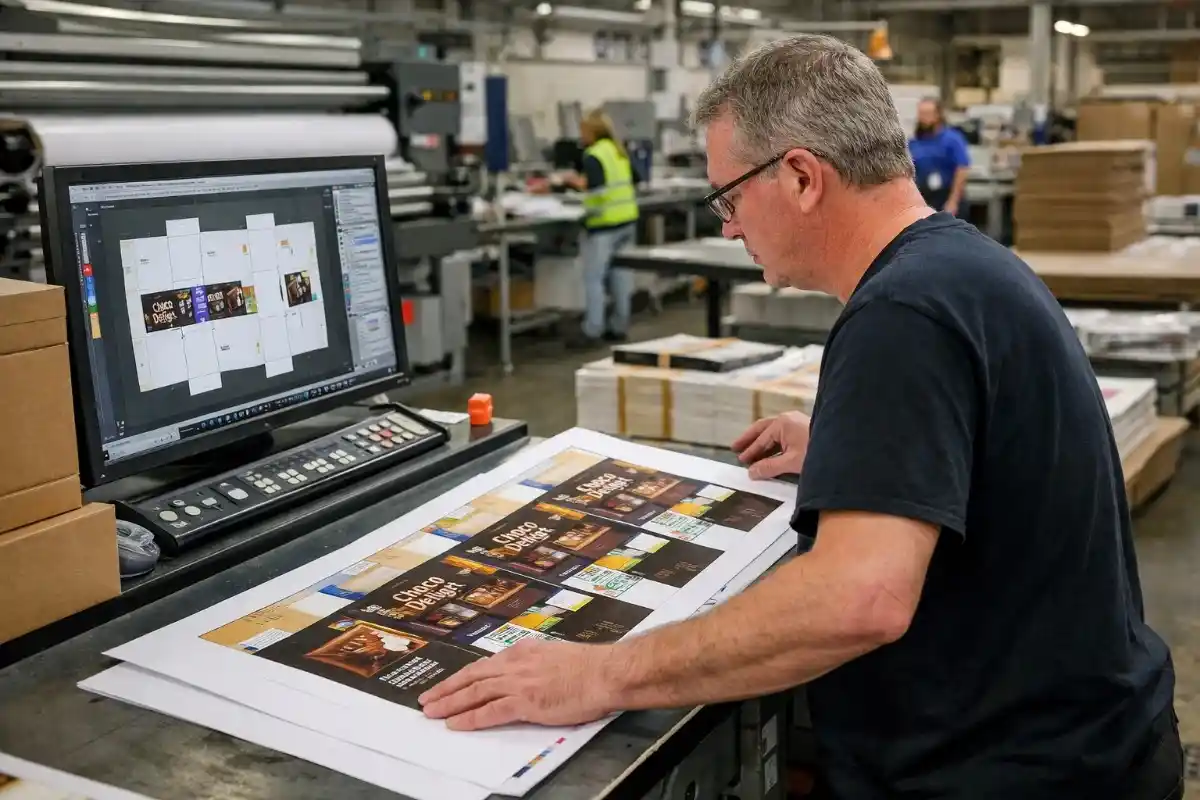
Corrugated packaging sits at the intersection of structural engineering and print production, where design intent must survive physical realities. Unlike other substrates, corrugated introduces variables that directly influence print accuracy, colour behaviour, and final output consistency. This makes corrugated packaging prepress a specialised discipline rather than a simple extension of standard workflows.
In real production environments, printers often discover that files prepared for folding cartons or labels fail when applied to corrugated boards. The differences are not minor adjustments but fundamental shifts in how artwork interacts with material structure. This is where specialised prepress handling becomes critical to ensure design intent translates accurately on press.
For trade printers, packaging converters, and print brokers, this challenge becomes operational. Managing these complexities internally can slow production, increase waste, and create inconsistencies across jobs. This is where digital prepress services support efficient corrugated packaging prepress workflows without increasing internal pressure.
Table of Contents
Toggle1. Material Behaviour Drives Prepress Decisions
Artwork cannot be treated uniformly across corrugated surfaces. Areas above flute peaks will print differently from those above valleys. Without the right prepress adjustments for corrugated packaging, this can cause banding, broken lettering, and distorted visuals during production.
Packaging prepress providers adjust files based on flute direction and board type to ensure consistent, repeatable print results. These corrections compensate for pressure variation, ink absorption, and surface inconsistency across the board structure, making them a critical part of corrugated packaging prepress.
2. Flute Direction Impacts Print Accuracy
Flute direction plays a critical role in how graphics are perceived on corrugated packaging. When artwork runs parallel to the flute, distortion and compression effects become more visible, making early layout evaluation essential.
Prepress teams must evaluate layout orientation early in the workflow. Ignoring flute direction often results in stretched or uneven visuals after printing. In high-volume production, this results in rework, delays, and material waste.
Effective solutions account for these variables through practical adjustments:
- Align artwork direction with flute structure to reduce distortion
- Reinforce fine text and thin lines for better print stability
- Optimise layout positioning to maintain visual balance across panels
These considerations are rarely part of generic workflows. This is where specialized corrugated packaging prepress expertise becomes essential, ensuring consistent and reliable production outcome.
3. Dot Gain Challenges On Rough Surfaces
Dot gain is aggressive on corrugated boards due to their absorbent, uneven surfaces. Ink spreads beyond its intended boundaries, making images appear darker and less defined.
Managing this behaviour is a critical part of prepress preparation. In production, it leads to muddy shadows, loss of highlight detail, and reduced image clarity. Proper adjustments help teams maintain high-quality output despite surface complexities. Prepress teams handling packaging prepress services address this by recalibrating tonal curves and strategically reducing ink coverage.
These refinements are essential for maintaining accuracy and consistency across production workflows. In fast-moving environments, many print businesses rely on outsourced prepress services to efficiently manage these corrections. This approach supports consistent corrugated packaging prepress outcomes while maintaining turnaround expectations.
4. Flexo Printing Requires Precise Trapping
Flexographic printing, commonly used for corrugated packaging, introduces its own set of alignment challenges. Plate movement, substrate compression, and press speed can cause slight misregistrations during printing.
To prevent visible gaps or overlaps, trapping becomes a critical part of prepress preparation. However, trapping for corrugated requires a different approach compared to offset or digital workflows.
In practice, effective trapping strategies in corrugated workflows focus on controlling risk without compromising design integrity:
- Expand trap widths to absorb movement during printing
- Adjust colour sequencing to improve ink overlap behaviour
- Balance trap strength to avoid visible halos or edge distortion
Generic prepress services often apply standard trapping rules, which are insufficient for corrugated packaging prepress requirements. Specialised handling ensures both accuracy and visual consistency.
5. Comparing Standard And Corrugated Workflows
Understanding the gap between standard and corrugated workflows helps explain why dedicated approaches are necessary. The operational differences are structural rather than incremental.
| Prepress Factor | Standard Workflow | Corrugated Workflow |
|---|---|---|
| Dot Gain | Generally stable and easier to predict | Higher gain due to absorbent and uneven board surfaces |
| Trapping | Narrow, standard settings often sufficient | Requires customised trapping to manage press movement |
| Trap Width | Minimal adjustments in most jobs | Wider settings often needed for flexographic tolerance |
| Substrate Handling | Smooth sheets with consistent surface response | Board structure varies by flute type and liner material |
| Artwork Alignment | Focused on flat sheet registration | Must account for folds, panels, and assembly points |
| Colour Control | More consistent across standard substrates | Influenced by board type, ink holdout, and compression |
| File Checks | Standard preflight and resolution checks | Includes structural layout, panel fit, and print behaviour checks |
| Press Conditions | Stable offset or digital environments | Greater movement and variation in flexographic production |
This comparison highlights that corrugated packaging prepress is a distinct process. Treating it as a variation leads to inefficiencies and inconsistent output across production cycles.
6. Large Format Prepress Adds Complexity
Corrugated packaging often overlaps with large-format prepress, especially in retail displays and bulk packaging. These applications introduce additional variables such as scale, viewing distance, and structural die-lines.
At larger sizes, even small distortions become highly visible. Misalignment, colour inconsistency, or incorrect scaling can significantly affect the final presentation. This increases the importance of precise corrugated packaging prepress execution.
Prepress teams must ensure consistent scaling, precise alignment, and seamless colour continuity across all panels. These requirements highlight the need for integrated outsourced prepress services that combine packaging expertise with large format capabilities to deliver accurate, production-ready results.
7. Why Generic Prepress Workflows Fail
Many print businesses rely on standardised workflows designed for efficiency across different job types. While effective for general printing, these workflows are not suitable for corrugated packaging. The core issue is the lack of substrate-specific adjustments. Generic workflows do not account for flute direction, dot gain, or flexo-related variables.
Without dedicated handling, files that appear correct digitally often fail during production. This gap creates operational inefficiencies. Teams spend additional time correcting preventable issues, which impacts turnaround time and cost control.
Packaging prepress companies specialising in corrugated packaging prepress address these challenges by building workflows around real production conditions. Prepress workflows should follow recognised quality management principles such as ISO 9001 to improve consistency, reduce avoidable errors, and strengthen production control across repeat jobs.
8. Building Reliable Corrugated Prepress Systems
Developing a reliable workflow requires structured processes that align closely with real production conditions. A strong system focuses on applying precise adjustments at critical stages, ensuring that file preparation supports consistent press performance rather than reacting to issues later.

Effective systems include substrate-specific profiling, controlled trapping standards, and detailed artwork validation processes tailored to corrugated materials. Corrugated packaging prepress should comply with applicable packaging and labelling regulations to ensure all artwork is production-ready and meets required standards. These elements work together to maintain accuracy, reduce variation, and ensure consistent output across different jobs and production runs.
For many businesses, outsourcing through digital prepress services strengthens overall operational capability. Outsourcing prepress reduces internal workload while providing access to specialised expertise, allowing teams to manage complex requirements within corrugated packaging prepress without compromising efficiency or turnaround time.
9. Workflow Bottlenecks In Corrugated Production
Corrugated jobs often expose workflow gaps that remain hidden in standard print operations. File preparation delays, repeated corrections, and last-minute adjustments are common when prepress is not aligned with production realities. These inefficiencies slow down throughput and increase operational pressure.
In corrugated packaging prepress, bottlenecks typically occur during file validation and press readiness checks. Files may pass basic checks but still fail on press due to substrate behaviour. This creates a cycle of rework that impacts delivery timelines and resource allocation.
Production teams need workflows that anticipate these issues rather than react to them. Structured packaging workflow processes reduce reliance on manual corrections and improve handoffs between design, prepress, and press stages.
For growing print businesses, eliminating these bottlenecks is not just about speed. It directly impacts profitability, as fewer errors mean less waste, reduced downtime, and more predictable job execution.
10. Scalability Challenges In Packaging Prepress
As packaging volumes increase, maintaining consistency becomes more difficult. Corrugated jobs often involve multiple SKUs, variations, and repeat runs across different timelines. Without a scalable approach, managing these variations becomes operationally complex.
Corrugated packaging prepress must support repeatability across batches without introducing variation. This requires standardised processes that can handle multiple versions of the same artwork while maintaining alignment with production requirements.
In many cases, internal teams struggle to scale these operations efficiently. The workload increases, but the ability to maintain consistency does not. This creates gaps in quality control and delays in production cycles.
Outsourcing to specialised packaging prepress companies helps address this challenge. It allows businesses to scale operations without increasing internal overhead, while maintaining consistent output across all jobs.
11. Version Control Risks In Packaging Files
Version control is one of the most overlooked risks in corrugated production environments. Packaging jobs often involve multiple revisions, regional variants, and last-minute compliance updates. Without strict control, outdated or incorrect files can easily enter production.
In packaging workflows, even a minor version error can have far-reaching consequences. A wrong barcode, incorrect regulatory text, or outdated branding can result in rejected batches or costly reprints. These are not design issues but workflow failures.
The challenge increases when multiple stakeholders are involved, including design teams, brand managers, and production units. Files may be shared across systems without clear tracking, leading to confusion about which version is the final, approved one.
Effective corrugated packaging prepress workflows address this by implementing structured file management systems. This includes clear naming conventions, controlled approvals, and validation checkpoints before production. These controls ensure that only verified files move forward, reducing risk and maintaining consistency across all packaging outputs.
12. Conclusion
Corrugated packaging introduces variables that fundamentally change how prepress must be approached. From flute direction to dot gain and flexo trapping, each factor directly impacts print performance and consistency. This is why corrugated packaging prepress requires a specialised and structured approach.
By adopting dedicated prepress strategies, print businesses can reduce errors, improve efficiency, and maintain consistent production quality. These improvements translate into stronger operational control and better client outcomes.
If your team is looking to streamline workflows and reduce internal pressure, it may be time to work with experts in corrugated packaging prepress. You can request a quote from Alpha Prepress to streamline your packaging workflows with reliable, production-ready prepress support.
13. Frequently Asked Questions
What makes corrugated packaging production different from standard prepress?
Corrugated packaging prepress considers structural elements like flutes and uneven surfaces. These require specific adjustments not needed in standard workflows.
Why is dot gain higher in corrugated packaging prepress?
Can standard workflows handle corrugated packaging prepress?
What role does trapping play in flexo printing for corrugated packaging?
Is outsourcing prepress workflows for corrugated materials beneficial?
How does large format affect corrugated packaging production?

Kevin Bharmal leads Alpha Prepress, the white-label prepress division of the Alpha BPO group, supporting label, packaging, commercial, direct mail, sign, and wide-format printers with press-ready file preparation since 2006.