
What Commercial Printers Outsource in Print Prepress and Why
- March 2, 2026
- Prepress Services
- Kevin Bharmal
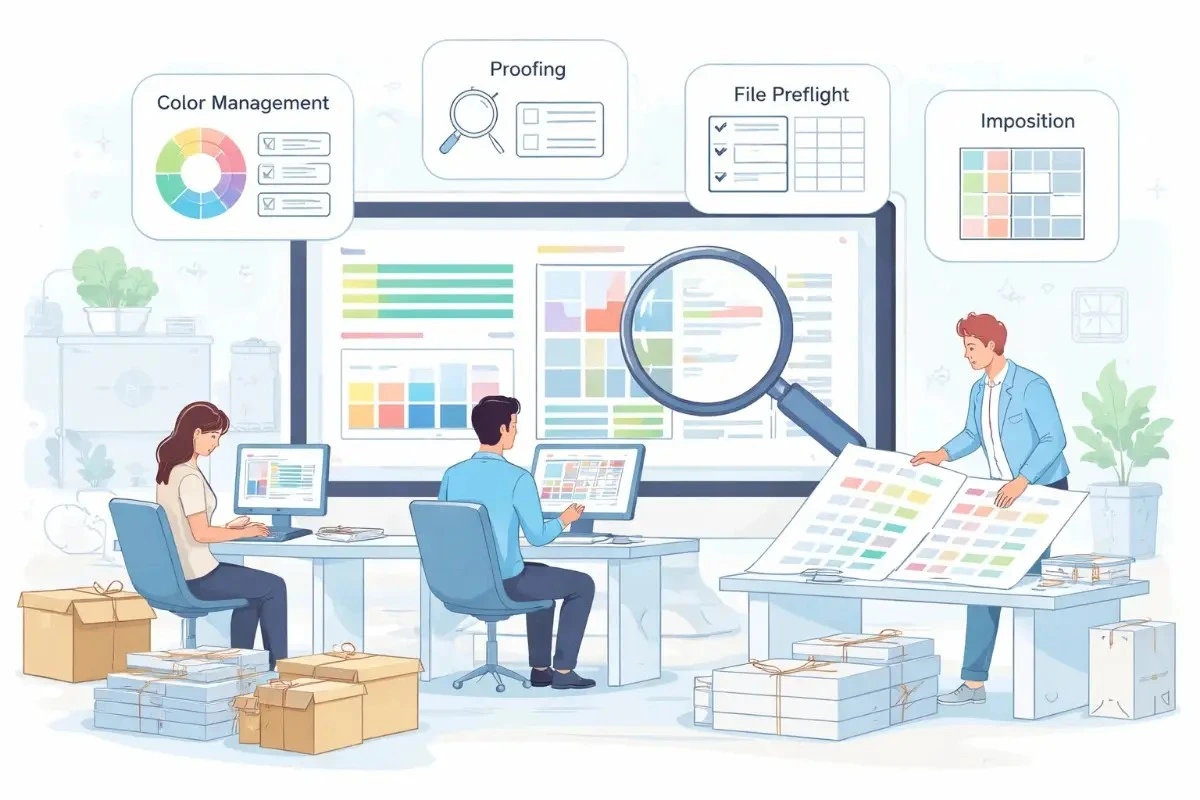
Over the last 10 years, commercial printing has changed significantly. Today, production is all about faster turnaround times, tighter margins, and more complicated artwork files.
Printers have to deal with changing workloads, formats, and client needs while getting the same results every time. Print prepress sits at the centre of these pressures, directly affecting job accuracy, press efficiency, and delivery timelines. These delays rarely occur in isolation. They disrupt schedules, increase material waste, and reduce press efficiency on the production floor.
This article talks about what commercial printers actually send out for prepress work and why those choices are important. It looks at real-life production situations, makes it clear which jobs stay in-house, and shows how outsourcing may help a business develop without losing control or quality.
Table of Contents
Toggle1. Print Prepress Services in Modern Print Operations
Most of the time, modern print operations do not work as closed systems. At the same time, production teams have to handle quoting, scheduling, machine availability, and client communication. Outsourcing prepress solutions has been a useful way to meet these complex operational needs.
Today, outsourcing does not mean losing operational control. Instead, it lets printers increase their output capacity while still meeting their own criteria. Many firms now see outside print prepress support as part of their own team rather than a distinct job.
This change is happening because jobs are becoming more complex and their number is hard to anticipate. Commercial work, such as packaging, signage, and multiple versions, often requires a lot of emphasis that internal teams do not always handle well.
2. Why Commercial Printers Outsource Commercial Prepress
Commercial prepress is outsourced by printers not just to save money, but also to keep their operations stable. Speed, predictability, and repeatable results are always more important than price. When internal teams approach their limits, outsourcing keeps production going.
Another problem is skill concentration. When one or two operators are responsible for preparing important print files, being absent or overworked is dangerous. Outsourcing distributes responsibilities while maintaining high professional standards.
Flexibility is another reason why companies choose to outsource. The demand for print prepress work fluctuates daily based on deadlines and job types. External support lets printers adjust their workload without hiring more people or risking fatigue.
3. Print File Preparation Tasks Commonly Outsourced
Printers usually hire other companies to handle prepress work that is repetitive, rule-based, and time-consuming. These tasks require accuracy and consistency, not creative judgment; they are ideal candidates for outsourcing to a reliable partner.
Some common print prepress jobs that are outsourced are:
- Preparing print files and making adjustments before they fly
- Fixing and improving the resolution of images
- Changes in color that match the press conditions
- Imposition for work on signs, digital, and offset printing
These chores take up a lot of time and do not really help the company stand out from the competition. By outsourcing, senior staff can focus on ensuring the task is done well, coordinating the workflow, and planning output.
4. Managing Overflow With Large Format Prepress
One of the biggest reasons printers use outside help for prepress is that they have too much work to handle. Even teams with ample resources can be overwhelmed by seasonal marketing, tenders, and promotions. Outsourcing helps relieve this pressure without breaking delivery promises.
Print prepress work in large formats is very hard. Signage and display graphics often have large files, multiple panels, and tight resolution requirements. Specialist handling makes things more accurate while keeping turnaround times safe.

Printers lower their error rates by outsourcing extra work rather than rushing it through their own systems. During busy production times, this method protects press schedules, material efficiency, and client trust.
5. Prepress Workflow Tasks Kept In-House
Not every print prepress task can be handled by an external provider. Many printers still do jobs that require making decisions based on context or working closely with clients. Being close to the sales and manufacturing teams is helpful for these tasks.
Some common in-house prepress duties are:
- Initial file review during the quoting stage.
- Talk about and approve client artwork.
- Decisions over colors for the press
- Last approval before printing
These functions depend on a deep understanding rather than rapidity of execution. Keeping print prepress in-house ensures accountability, while outsourcing handles heavy production labor.
6. Where Control Matters in Packaging Prepress
Printers remain cautious about outsourcing jobs that directly affect the integrity of their brand. Packaging prepress frequently requires following rules, ensuring dielines are correct, and checking strict brand guidelines, which someone inside the company must review.
But outsourcing is still helpful. External teams ensure files are technically correct, while internal teams handle approvals and communication. Control remains the same without increasing the load on capacity.
This mixed approach shows that the workflow design is mature. Print prepress strikes a balance between efficiency and accountability, allowing printers to manage risk without slowing production.
7. Integrating Outsourced Prepress Workflow Daily
For outsourcing to work, the workflow must be easy to integrate. The best configurations do not add new systems; they copy what is already there.
Files usually go through set checkpoints. Internal teams conduct the initial evaluations, outsourced teams handle the work, and final checks are conducted before the press release. This arrangement prevents repetition and clarifies things.
A good prepress company knows how to work with naming conventions, job tickets, and turnaround times. When everything is in the right place, outsourcing print prepress feels like it is part of the business.
8. Real-World Prepress Services Production Example
Think about a commercial printer that can print catalogs, signs, and packaging all at the same time. Internal print prepress handles quotes and client communication, while outsourced teams work on large-scale layouts overnight.
Files are ready to be printed by morning. Staff members inside do final checks and release jobs right away. Presses work well, and deadlines are still safe.
This model shows how outsourcing prepress services can help keep things going. It helps internal teams without moving them or disrupting the production controls already in place.
9. Speed, Capacity, and Print Prepress Company Consistency
Speed is still a major reason to outsource. Prepress services that run overnight and overseas let production cycles continue without requiring longer hours in the office.
Another benefit is that you can increase capacity without spending money on infrastructure. When a company grows, outsourcing means they do not need to buy more technology, software licenses, or training.
The quieter benefit is consistency. Structured quality checks make jobs, operators, and timeframes more consistent, which makes everything more reliable.
10. Commercial Prepress Benefits at a Glance
| Business Need | In-House Impact | Outsourcing Advantage |
|---|---|---|
| Peak workload | Overtime fatigue | Scalable capacity |
| Complex files | Slower processing | Specialist handling |
| Tight deadlines | Production pressure | Faster turnaround |
| Quality control | Operator dependency | Standardised checks |
This comparison shows why outsourcing is a better long-term solution than short-term repairs.
11. Risk Reduction Through Expert Prepress Services
Outsourcing also helps reduce operational risk. Mistakes in print prepress cause reprints, wasted materials, and missed deadlines. External teams add a new layer of assessment that identifies problems early.
Outsourcing is a second quality check for many printers. Files examined outside generally return cleaner, improving press performance and reducing downtime.
Outsourcing can make production more resilient, rather than introducing unpredictability, when done right.
12. Choosing the Right Print Prepress Company Partner
Not all prepress partners are worth the same amount. For outsourcing to work, processes must be in sync, communication must be clear, and technical skills must be strong across all print formats.
Strong partners know how to work in commercial prepress, packaging, and signage settings. Instead of imposing inflexible systems, they adapt to each printer’s workflows.
It is also important to keep files safe, private, and in good shape. Reliable partners respect the privacy of the artwork. Guidance from the National Institute of Standards and Technology highlights the importance of managing risk in outsourced workflows through clear controls and approvals.
13. Conclusion
To maintain high speed, capacity, and uniformity without further stressing their own staff, commercial printers outsource print prepress. Repetitive tasks that require a high level of technical skill are handled externally, while strategic decisions remain in-house. This balance reflects how work is done today. Alpha Prepress is an expert at safely, precisely, and at scale handling outsourced prepress work.
If your team needs overflow support or prepress services aligned with your workflow, get in touch with Alpha Prepress to request a quote. It supports smoother production and stronger operational control.
14. Frequently Asked Questions
What do people usually outsource in print prepress?
Does outsourcing make it harder to maintain quality standards?
Is it safe to outsource prepress packaging?
How does outsourcing fit into the daily production schedule?
Is it okay for small print shops to outsource?
Does offshore prepress change how long it takes to get something done?

Kevin Bharmal leads Alpha Prepress, the white-label prepress division of the Alpha BPO group, supporting label, packaging, commercial, direct mail, sign, and wide-format printers with press-ready file preparation since 2006.