
What Are Prepress Services? A Complete Guide
- November 29, 2025
- Prepress Services
- Kevin Bharmal
Quick Summary:
- Prepress is the technical stage between design and printing.
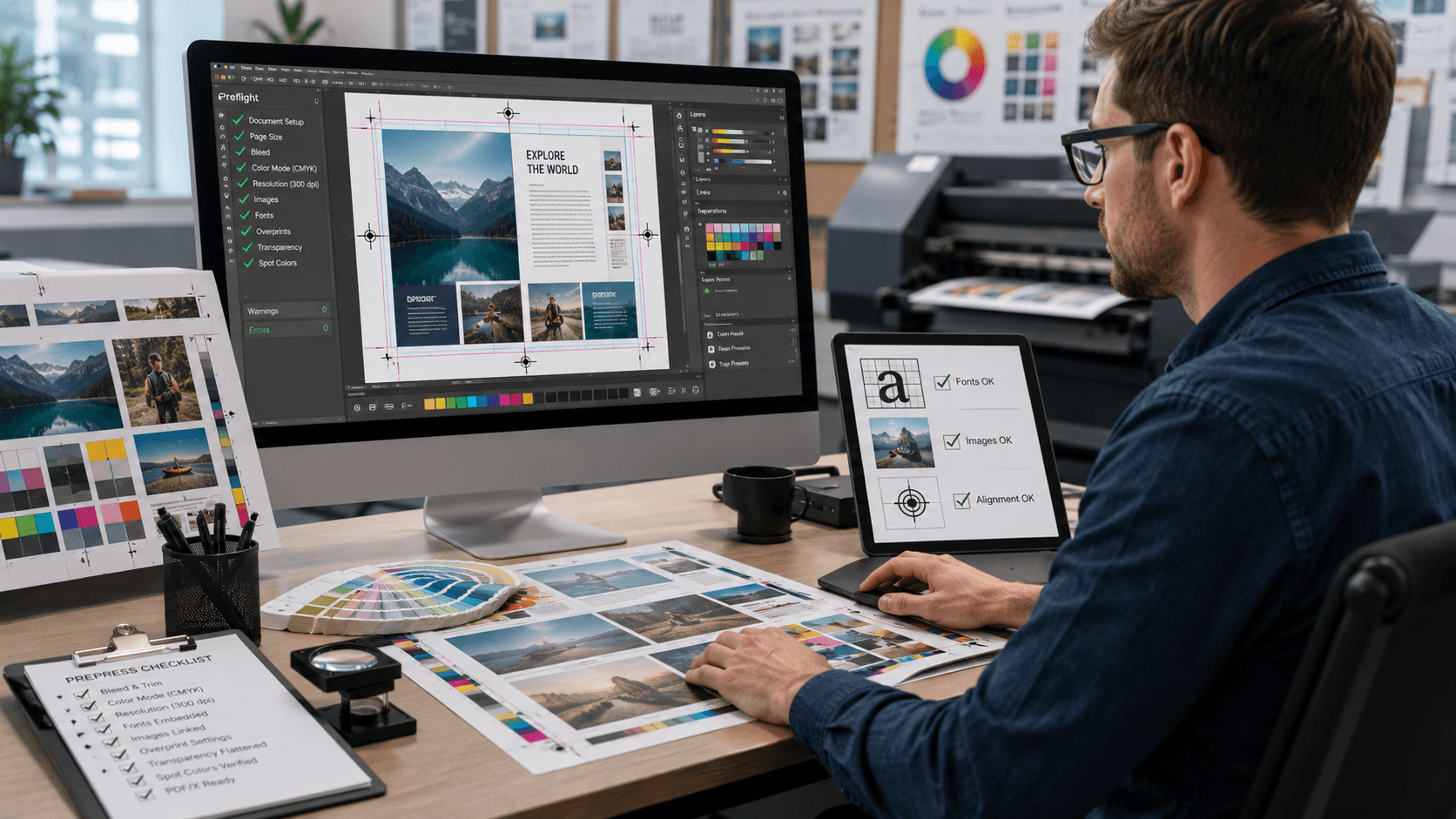
- It includes preflight checks, color management, proofing, imposition, and file preparation.
- Proper prepress reduces reprints, delays, and production errors.
- Requirements vary across commercial printing, packaging, labels, and large-format work.
- Printers can manage prepress in-house, outsource it, or use a hybrid model.
Introduction:
Prepress is the stage between a finished design and a running press. A design can look complete on screen and still not be ready to print. Prepress is the work that closes that gap, the difference between a file that looks right and a file that runs clean.
Most people outside the print floor never hear the word, yet it decides whether a job goes smoothly or turns into a reprint. When prepress is done well, the press starts on time, and the printed result matches what was approved. When it is skipped or rushed, the problems surface later, on the plate or on press, where they are slow and expensive to fix.
This guide explains what prepress services are, where they sit in the print workflow, what they involve, and how print businesses decide whether to handle them in-house or outsource them.
Table of Contents
ToggleWhere Prepress Sits in the Print Workflow
Every print job moves through the same four stages, in order:
- Design. A designer builds the layout: text, images, color, and structure. This is the creative stage, and most printers no longer treat it as part of prepress.
- Prepress. The file is checked and prepared for the specific press, substrate, and finishing the job will use. This is the technical bridge, and it is what this guide is about.
- Press. Ink goes on paper, board, vinyl, or fabric, using the prepared files or plates.
- Finishing. Cutting, folding, binding, laminating, and mounting. The printed sheet becomes the finished product.
Prepress is the only stage that touches every other one. It reads back to the design to catch what will not print, and it reads forward to the press and the finishing line to make sure the file holds up under real production conditions. A file can look perfect in isolation and still fail on a folder or a die-cutter if prepress did not account for it.
What Prepress Services Actually Include
“Prepress” is a single word for a set of distinct operations. The main ones:
Preflight. An automated and manual check of the file against the job’s requirements: fonts embedded or outlined, images at usable resolution, correct color mode, bleed present, links intact, and no broken transparency. Preflight is where most problems are caught, before they become expensive.
Color management: Converting and correcting color so the printed result matches what was approved. This means moving RGB to CMYK where needed, handling spot and Pantone colors, setting rich black and total ink coverage, and applying the right profile for the substrate. The same red prints differently on coated stock than on kraft, and color management accounts for that.
Bleed, trim, and safe-zone correction: Extending artwork past the trim line so a slight shift on the cutter does not leave a white edge, and keeping critical text inside the safe zone so it does not get trimmed off.
Dieline and structure checks: For anything that folds, cuts, or assembles, the artwork has to fit the dieline exactly. Prepress verifies that the dieline sits on its own layer, the artwork aligns to it, and folds, creases, and glue tabs are accounted for.
Trapping and overprint: Adjusting how adjacent colors meet so a small misregistration on press does not show as a white gap, and reviewing overprint and knockout so nothing disappears or doubles unexpectedly.
Imposition: Arranging pages or repeated artwork on the press sheet so the job runs efficiently and, after folding and cutting, ends up in the right order. Good imposition saves paper and press time.
Proofing: Producing a digital or physical proof that shows how the file will behave in production. The proof is the agreement between you and the job: if it is right here, it should be right on press.
Output: Exporting the final press-ready file, usually PDF/X, or producing plates for offset. Crop marks, registration, separations, and export settings all get a last check before handoff.
Not every job needs every step. A simple flyer and a shrink-sleeve label are different problems. But the discipline is the same: verify against how the job will really be produced, correct what is flagged, and prove it before it runs.
Why Prepress Matters
The value of prepress is mostly invisible, which is why it gets underrated. It shows up as the absence of problems: presses that start on time, color that matches the proof, jobs that do not come back.
The cost of skipping it is the opposite, and it compounds. A missing bleed, an RGB image, an unembedded font, a dieline that does not fit. Each looks minor on screen. Each becomes a stoppage once the job is on press, where fixing it means pulling the run, correcting the file, and starting again on fresh material. A correction that costs minutes in prepress costs hours and a reprint on press.
There is a quieter benefit, too. Files that arrive press-ready let a print business plan with confidence. Schedules hold, press time is used instead of spent on corrections, and the same job runs the same way next time. Reliability is what keeps print clients, more than price.
Prepress for Different Print Formats
Prepress is not one fixed process. What a file needs depends on what is being printed and how it will be finished.
Commercial printing for brochures, flyers, catalogs, and business cards is built around imposition, pagination, and color consistency across a run.
Packaging and labels add structural complexity such as dielines, spot and brand colors, trapping, and finish layers, where the file has to account for how the package is built, not just how it looks. This is specialist work, covered in depth in our guide to packaging prepress tips.
Large format and signage shift the focus to scaling, resolution at viewing distance, panel alignment, and substrate behavior across big surfaces.
Direct mail and variable data bring data-merge accuracy, address formatting, and postal layout into the file.
Each format is a different problem with the same underlying discipline. A workflow built for flat commercial sheets will not handle a folding carton or a forty-foot banner without adjustment.
In-house or Outsourced Prepress
Every print business eventually decides whether to run prepress internally, hand it to a specialist, or do both. There is no single right answer; it depends on volume, mix, and how predictable the workload is.
Factors | In-house prepress | Outsourced prepress |
Expertise | Limited to your team’s skills | Specialists across many formats and jobs |
Equipment and software | You buy and maintain it | Included in the service |
Cost structure | Fixed: salaries and overhead | Variable: scales with workload |
Scaling | Requires hiring | Capacity up or down on demand |
Turnaround | Fast when the team is free | Extended through overnight and overflow support |
Control | Direct, files stay internal | Maintained through a defined workflow and NDA |
In-house gives the tightest control and works when volume is high enough to keep a skilled team busy year-round. The risk is concentration: when one person holds the prepress knowledge and leaves, the workflow is exposed.
Outsourcing converts a fixed cost into a variable one and gives access to specialists without carrying the headcount. It handles overflow during spikes and keeps jobs moving overnight. The dependency is on choosing a partner who understands real production, not just software.
Many print businesses run a hybrid model: the internal team handles client communication, approvals, and jobs that require on-site judgment, while routine file prep, overflow, and format-specific work go to an outsourced partner. That keeps control where it matters and adds capacity where it helps.
How Alpha Prepress fits in
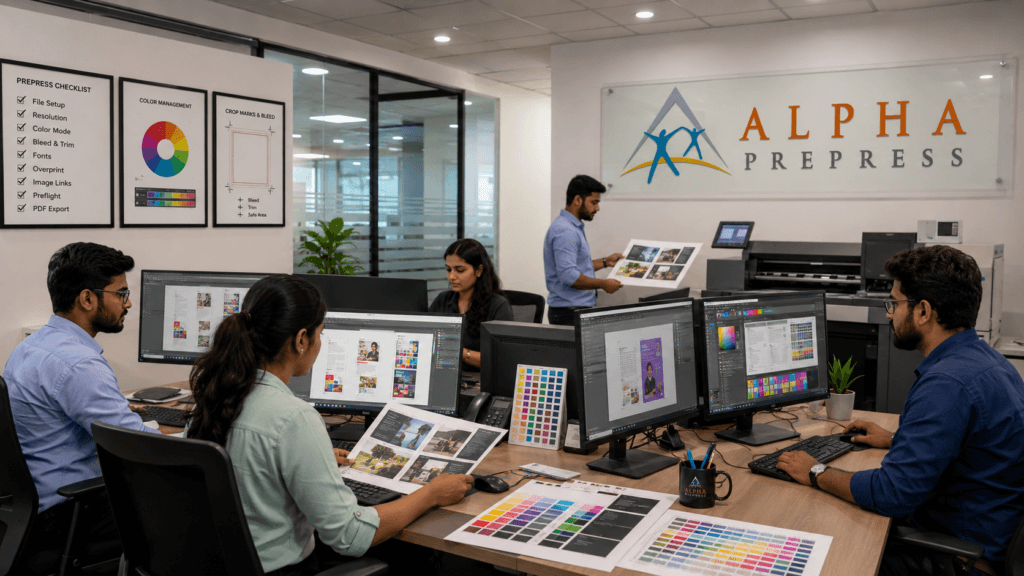
Alpha Prepress is the outsourced and white-label side of that decision. Print businesses send us files, we preflight, correct, and impose them against your output specs, and we return press-ready work, either under your brand or alongside your team.
If you want to see the quality before you commit, send a live production file as a free trial. We return it press-ready, no commitment, so you judge the output on a real job rather than a promise.
Try us with a real job → Free trial. No commitment.
