
How Flute and Board Grade Change a Corrugated Dieline
- September 17, 2026
- Packaging Prepress
- Kevin Bharmal
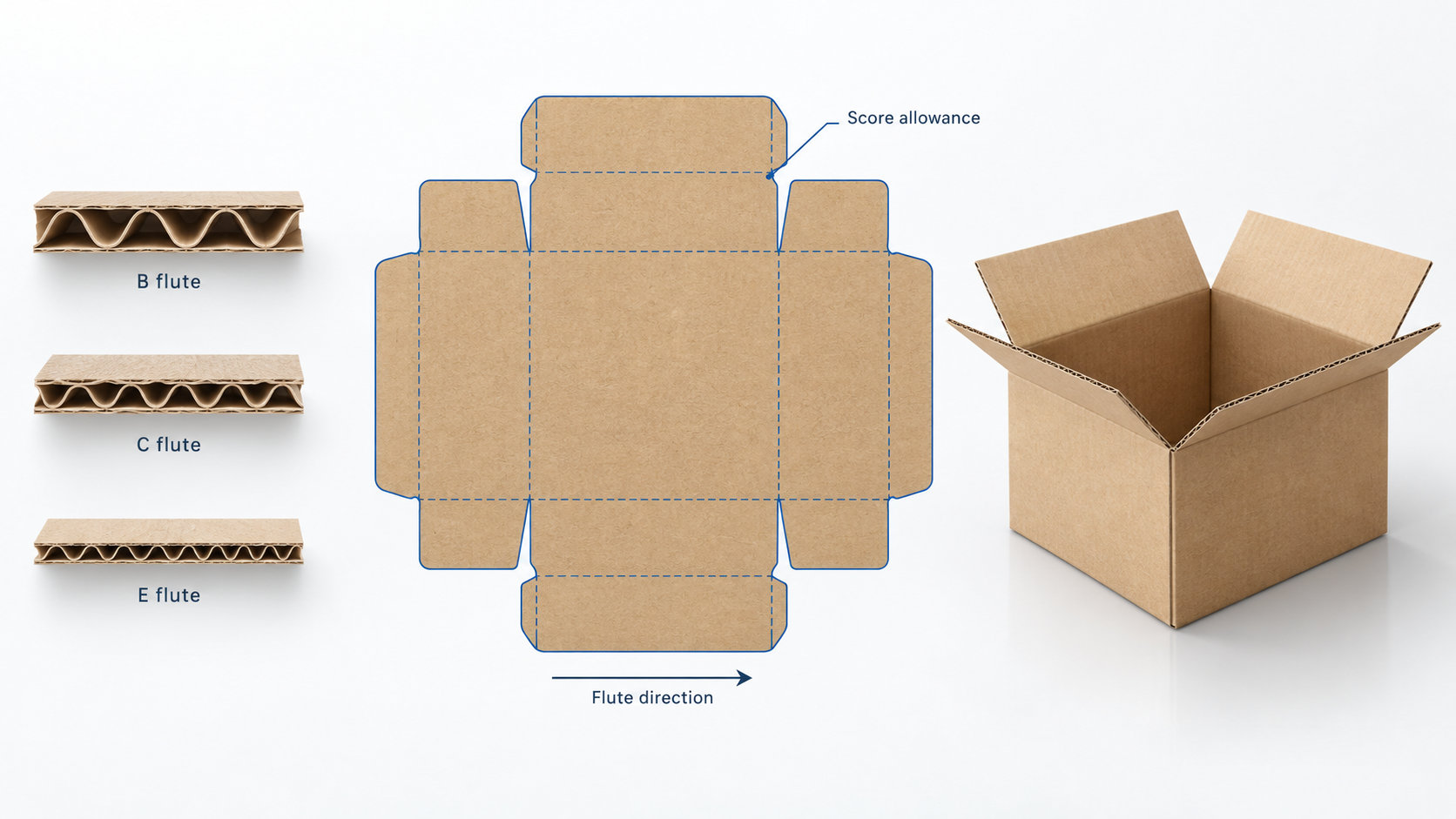
Two boxes can share the same FEFCO code, the same internal dimensions, and the same artwork, and still need two different dielines. The variable is the board. Flute profile and board grade decide how thick the wall is, how much material every fold consumes, and how the printed surface behaves. A corrugated dieline built without them will cut, crease, and print in the wrong places, and nobody finds out until the blank comes off the cutter.
This is one of the main reasons corrugated packaging prepress takes a different approach from folding carton work. The board spec is an input to the file, not a note on the purchase order. Here is what changes, and where files usually go wrong.
Table of Contents
ToggleThe Flute Sets the Geometry Before Artwork Starts
A corrugated sheet is a fluted paper medium glued between flat liners. The arch of that medium, the flute, comes in five common profiles: A, B, C, E, and F. The letters follow the order the profiles were developed. The lettering does not indicate flute size, so C flute sits between A and B in height.
Typical flute heights are approximately 4.8 mm for A flute, 3.6 mm for C, 2.4 mm for B, 1.2 mm for E, and around 0.5 to 0.8 mm for F and similar microflutes, excluding the facings.
Actual board callipers vary with the liner, medium, and supplier specification. C flute is commonly used for shipping cases. B flute is often selected where print quality and die cutting performance are important. E and F, the micro flutes, behave closer to heavy paperboard and carry fine graphics well.
For prepress, the profile matters because it sets board thickness, and board thickness enters the geometry around every fold and score in the box. A dieline is not a drawing of a shape. It is a drawing of a shape plus the material it will be folded from.
Score Allowances: Where Corrugated Dielines Go Wrong First
Corrugated cases are commonly specified by internal length, width, and height. When those dimensions are translated into a flat blank, the crease positions and board thickness have to be accounted for. That is where the converter’s score allowances come in: each panel gains an allowance so the erected case delivers the specified internal space.
The allowance generally increases as the board caliper increases, but there is no single allowance table that applies to every plant. Board construction, scoring tools, converting equipment, and the converter’s own standards all affect the final values. The production dieline should follow the allowance chart supplied or approved by the converter running the job.
The practical consequence: the same 12 x 5 x 8 inch RSC produces a different blank in B flute than in C flute, and the differences accumulate across a four-panel wrap plus the manufacturer’s joint. Reuse a B flute dieline for a C flute order and the resulting differences can affect the manufacturer’s joint, flap alignment, erected dimensions, or performance on the packing line.
Board Grade Changes the Blank, Not Just the Strength
A FEFCO code identifies the structural style of the package. It does not by itself define the flute, board construction, liner combination, or converter-specific score allowances. A 0201 in single-wall B flute and a 0201 in double-wall BC are the same style and two different production files.
Problems often appear when the board specification changes after the dieline has already been built. Moving from single-wall to a thicker double-wall construction without recalculating the scored dimensions can noticeably reduce the usable internal space. The product may fit differently, the flaps may no longer meet correctly, and the manufacturer’s joint may move out of position. The fix is never to scale the old dieline. It is to rebuild the blank from the internal dimensions with the new board’s allowances.
Board grade also fixes the flute direction through the blank. Flutes run one way, and creases that run across the flutes fold differently from creases that run with them. A well-built corrugated dieline records the flute direction and keeps the structure, and later the artwork, honest about it.
The Print Side: Flute Shows Up in the Artwork Rules
Most corrugated is printed post-print flexo, meaning the finished board goes through the press. On coarser flutes, the ridges telegraph through the liner under impression; the ripple effect known as washboarding or fluting shows.
It is not a press fault. It is the board’s structure showing up in the ink film, and it gets worse as the flute gets bigger and the impression gets heavier. These print-behavior variables are a big part of why corrugated prepress needs a different approach from other formats.
That drives real artwork rules. Post-print corrugated generally uses coarser screening than high-resolution offset work, so fine serifs, very thin rules, small reversed-out type, and delicate tonal transitions need to be evaluated against the converter’s actual press and board specifications.
Micro flute boards tolerate finer work. Kraft liners add their own variable: the brown, more porous surface changes ink holdout and dot gain, and color tolerances that are realistic on a white top liner are not realistic on kraft.
Litho lamination flips the logic. The sheet is printed flat on an offset press, then laminated to the corrugated board, so fine detail and tight color survive. But the dieline now has to account for the laminated top sheet: wrap distances, lamination margins, and trim allowances to the converter’s spec. Different process, same principle. The board decides what the file must contain.
Barcodes, Registration, and Production Clearances
Registration on post-print corrugated is looser than on folding carton offset. Board warp and caliper variation move the sheet through the press, so critical elements need more distance from scores, slots, and panel edges than carton habits suggest, with the safe margin scaled to the flute.
Barcodes deserve their own line in the checklist. Bars that run across the flute ridges pick up the surface ripple, and that surface distortion can reduce barcode readability. Orientation relative to the flute direction, bar width reduction, and print process all need to be settled in prepress and verified against the converter’s guidance, not left to whatever the label panel happens to allow.
Glue areas, slots, and coating windows also need specific attention: glue tabs and slot areas often need to stay ink-free, and coating windows must clear the manufacturer’s joint. These constraints live on the dieline layers, which is why layer discipline matters as much on corrugated as it does on folding cartons.
Why This Matters at Volume
The thread running through all of this: a corrugated dieline is board-specific. When the flute or the grade changes, the file changes, and the correct response is a rebuild from the inside dimensions with the right allowance chart, never a rescale of the old blank.
At one-off quantities, a wrong allowance is an annoyance. Across a repeat program running thousands of cases a week, it is a skid of misfolded boxes, a stopped packing line, and a customer asking why the joint gap wanders.
Corrugated Prepress Support When Workload Increases

Corrugated jobs require the board specification, dieline, artwork, and converter requirements to stay aligned from the beginning. When those inputs change, the production file needs to change with them.
Alpha Prepress has supported commercial printers and packaging operations since 2006, providing dieline services, artwork checks, preflight, and other packaging and label prepress services.
Our team works within your existing production requirements and converter-supplied specifications, with same-day or overnight turnaround available depending on job scope.
If corrugated work is putting additional pressure on your internal prepress team, talk with us about supporting your workflow.
Frequently Asked Questions
Can I reuse a folding carton dieline for a corrugated version of the same pack?
No. Folding carton board and corrugated board have different thickness, crease behavior, and production requirements, so the allowances and safe margins differ as well. Start from the corrugated board specification and rebuild. Our folding carton dieline setup checklist covers the carton side of that comparison.
The style and dimensions are unchanged. Only the flute changed. Do I need a new dieline?
Yes. The required finished dimensions may remain the same, but changing the flute changes the board caliper and can change the allowances used to construct the blank. Recalculate or verify the production dieline for the new board specification.
Why does the converter's template disagree with my CAD file?
Allowance charts vary from plant to plant because they reflect each converter’s board combinations, scoring tools, and equipment. When the two disagree, the converter’s numbers govern. Verify the dieline against, or have it supplied by, the plant that will run the job.
Which flute is best for printing?
For fine graphics, micro flutes such as E and F, or litho lamination on any flute, give the smoothest result. B flute is the common compromise for direct printed retail work. A and C carry bold, simple graphics well but aren’t the right choice for fine detail.
