
Folding Carton Dieline Setup Checklist for Packaging Prepress
- July 3, 2026
- Prepress Services
- Kevin Bharmal
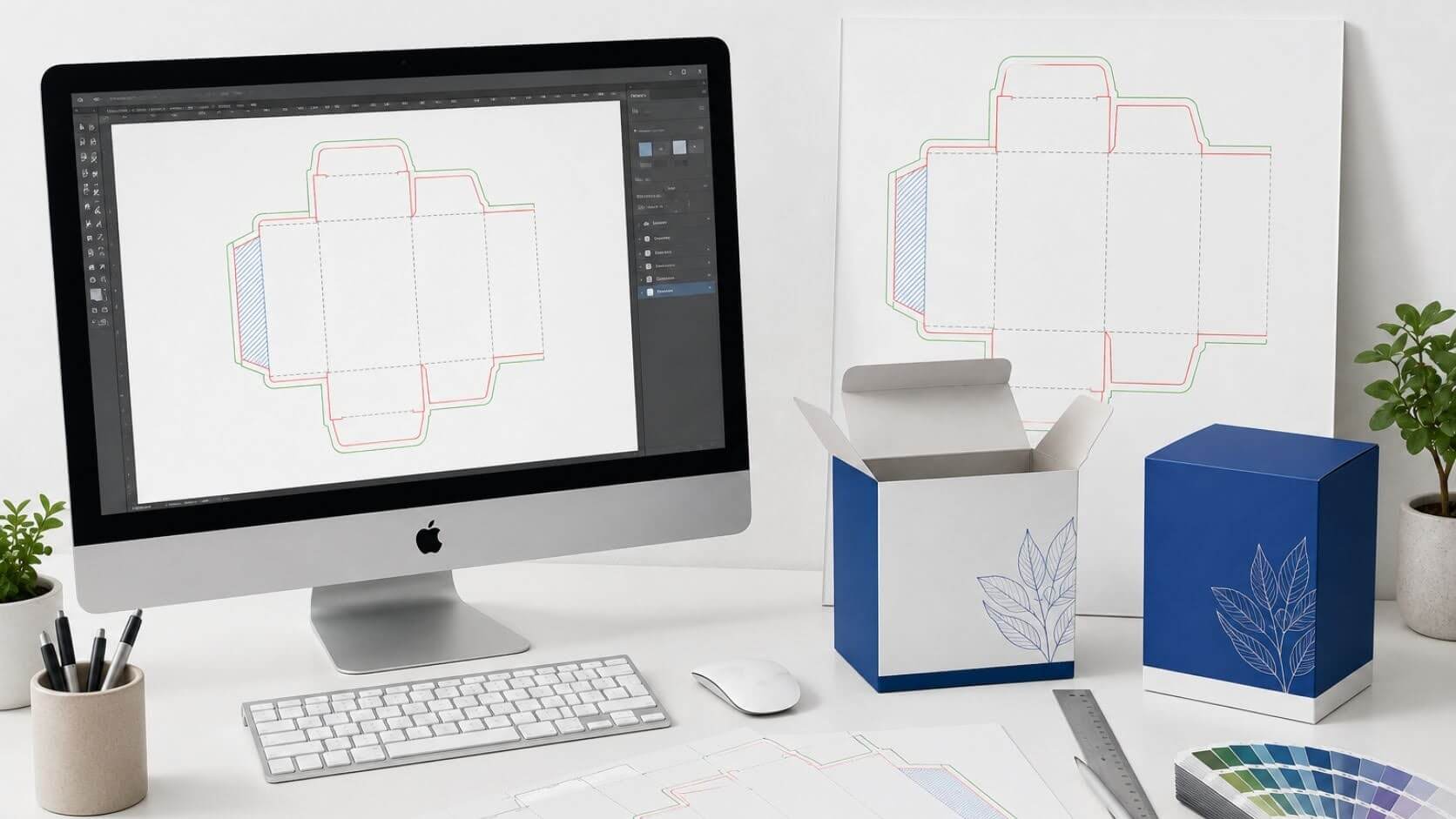
A folding carton can look flawless on screen and still fail on the cutting table. A white sliver appears along a folded edge. A barcode cracks where it crosses a score. A glue flap refuses to bond because varnish crept into the seam. None of these problems shows up in the design file. They show up after the die hits the board, when a reprint is the only fix.
The dieline is where most of these failures are either prevented or created. It is the flat structural template that tells the die-maker where to cut, where to crease, and where the board folds into a finished carton. Get the dieline right, and the artwork has a stable frame to sit inside. Get it wrong and even perfect artwork prints on a carton that will not assemble cleanly.
Correct folding carton dieline setup is the difference between a clean run and a scrapped one, and it sits at the center of professional packaging prepress services.
This guide walks the line types a folding carton dieline needs, the layer and spot-color setup that keeps the dieline off the printed sheet, a checklist to run before release, and the three dieline mistakes that most often force a rerun.
Table of Contents
ToggleWhat a Dieline Actually Is
A dieline, sometimes called a keyline, is a vector template that maps the structural geometry of a folding carton in its flat, unfolded state. Every cut, crease, perforation, and glue area is drawn as a line, and each line type carries a specific instruction for a different stage of production.
The die-maker reads the cut and crease paths to build the cutting die. The folder-gluer relies on the crease positions and glue areas. The press operator needs the dieline to align the artwork to the structure.
Because the dieline drives tooling rather than ink, it is not artwork. It is a set of instructions that happens to travel in the same file as the artwork, which is exactly why it needs to be isolated cleanly.
The Line Types Every Folding Carton Dieline Needs
A complete dieline uses a small, consistent set of line types. Each one should be a named, dedicated spot color, never a process build, and never a stray stroke left on the artwork layer.
- Cut lines: the through-cut profile of the carton, including the outer edge and any windows, hang holes, or dispensing openings. Drawn as solid paths.
- Crease or score lines: where the board is scored so it folds without cracking. Drawn as dashed paths so they read differently from cuts at a glance.
- Perforation lines: partial cuts for tear-away strips or easy-open features.
- Bleed: artwork extended beyond the cut edge, so no unprinted board shows after trimming and folding.
- Glue areas: the flaps and seams that bond during folding and gluing, which must stay free of coating and heavy ink coverage.
- Safe zone or live area: the interior margin that keeps critical elements clear of cuts and folds.
Layer and Spot-Color Setup That Keeps the Dieline Off the Printed Sheet
The single most reliable habit in folding carton dieline prepress is separating structure from art. Build the dieline on its own technical layer, sometimes called the keyline layer, above the artwork, with every structural line assigned to a clearly named spot color: Cut, Crease, Perf, Glue.
Set each spot color to overprint so it does not knock a hole in the artwork beneath it, and flag the layer as non-printing so it never rasterizes into the final separations.
This setup does three things at once. The RIP can drop the dieline from the printed output. The die-maker can isolate the cut and crease paths to build tooling. And anyone opening the file can read the structure at a glance without hunting through the artwork. Consistent color naming matters here because a die-maker who receives a line called Cut knows exactly what it is, while a line called Spot Color 2 forces a phone call and a delay.
A prepress toolchain built around the major Adobe, Enfocus, and Esko ecosystems handles this cleanly, but the discipline is the same regardless of software:
- structure on its own layer
- named spot colors,
- overprint on,
- non-printing flag set
Aligning Artwork to the Dieline
Artwork and structure have to register to each other, not just sit in the same document. The dieline is the reference frame, so the artwork is positioned to it rather than the other way around. Panel by panel, the design should be read correctly once the carton is folded, which means checking orientation on every face, not only on the flat.
A back panel that looks right on the sheet can end up upside down on the assembled box if it was never checked against the fold sequence.
Working from the current, approved structural file is part of this. Dielines get revised, and a common source of scrap is artwork aligned to an earlier version of the die. Confirm the dieline revision before release, and align to that exact file.
The Prepress Checklist to Run Before Release
Run this on every folding carton file before it goes to the plate or die.
- Dieline on a separate, clearly labeled technical layer, set to non-printing.
- Cut, crease, perf, and glue lines each assigned to a named spot color, set to overprint.
- Bleeds present on every edge that will be cut, extended a consistent distance past the cut line (commonly 0.125 inch, or 3 mm, though tight folds and die tolerances can call for more).
- Critical elements such as text, logos, barcodes, and ingredient panels are held inside the safe zone, clear of cuts and creases.
- No live artwork sitting directly on a crease or fold.
- Glue areas free of varnish, coating, and heavy ink so the seam can bond.
- Barcode placed on a flat panel, free from any crease, with quiet zones intact and a bar-width reduction applied for the print process.
- Artwork aligned to the current dieline revision, not an earlier one.
- Panel dimensions confirmed against the structural spec, including board caliper allowance at the creases.
- Overprint and trap settings reviewed so knockouts and spot builds behave as expected on press.
Three Dieline Mistakes That Force a Reprint
1. Missing bleed at the fold
Designers often add bleed to the outer trim and forget the internal edges, which become visible once panels fold together. When a tuck flap or a side panel lacks bleed, folding reveals a thin line of bare board right where the eye lands. Sound carton bleed setup treats every cut edge as a bleed edge, then confirms the bleed survives the fold, not just the flat trim.
2. Artwork sitting on the crease
A logo, a line of body copy, or a barcode placed across a score line will distort, crack, or break as the board bends. Coated boards are especially unforgiving, since the coating fractures along a crease under stress. Keep meaningful artwork off the crease entirely, and give it enough clearance that normal folding tolerance does not pull it onto the score.
3. Wrong or unnamed spot-layer setup
When dieline lines are built in process colors, left on the artwork layer, or set to knock out instead of overprint, two things go wrong. The structure can print on the finished carton as visible lines, and the die-maker cannot cleanly separate cut from crease. Both send the job back. Named spot colors, overprint on, and a non-printing technical layer prevent it.
7. Integrating Outsourced Prepress Workflow Daily
For outsourcing to work, the workflow must be easy to integrate. The best configurations do not add new systems; they copy what is already there.
Files usually go through set checkpoints. Internal teams conduct the initial evaluations, outsourced teams handle the work, and final checks are conducted before the press release. This arrangement prevents repetition and clarifies things.
A good prepress company knows how to work with naming conventions, job tickets, and turnaround times. When everything is in the right place, outsourcing print prepress feels like it is part of the business.
Glue Flaps and Coating Windows
Glue seams are one of the most overlooked parts of a folding carton file, and they cause failures that only appear at the folder-gluer. Adhesive bonds to bare board, not to varnish or aqueous coating, so the glue area has to be masked out of any overall coating. When the coating runs edge to edge, and the glue flap is not knocked out, the seam either fails to hold or holds inconsistently across the run.
The practical step is to build a coating-free window over each glue area on the coating layer, sized to the glue flap with a small margin so slight shifts on press still leave a clean board for the adhesive. Heavy ink coverage in the same zone can cause similar bonding problems, so glue flaps are kept as light as the design allows. On the dieline itself, the glue areas stay marked as their own spot color, which makes them easy to check against the coating window before release.
Why This Matters at Volume
A single carton with a dieline error is a lost proof. A run of cartons with the same error is scrapped stock, remade tooling, and a missed ship date. Folding carton work moves in volume and on deadline, so the cost of a structural mistake is rarely small. The checklist above is deliberately short so it can run on every file, every time, without slowing the schedule.
For converters carrying peak-season volume or covering a staffing gap, outsourced prepress services can absorb the dieline and file-prep load so press time is not spent waiting on files. A specialist team handles dieline construction, artwork alignment, and preflight with same-day or overnight turnaround depending on scope.
Keep Your Presses Running With Prepress Experts

Dieline work is exacting, and it does not have to sit on an in-house team already stretched by press schedules.
Alpha Prepress has handled packaging prepress for print operations for 20+ years, since 2006 via the Alpha BPO group, working across an industry-standard prepress toolchain that spans the major Adobe, Enfocus, and Esko ecosystems.
Dieline construction, artwork alignment, and full preflight come back press-ready with same-day or overnight turnaround depending on scope, handled quietly and under your own label.
Whether it is a single rush carton or steady overflow through the busy season, put a reliable prepress team behind your next run.
Schedule a call to talk through your folding carton workload.
